
I‘ve written before about my love of investment acronyms, from TINA to TACO, BRICS to FANG. HALO is a new one I’ve seen lately. It stands for Heavy Assets, Low Obsolescence, which is definitely more fun as an acronym. HALO stocks, the thinking goes, are less vulnerable to disruption by artificial intelligence. That’s why they’ve appreciated while perceived AI losers have sold off.
I’m reminded of the “Old Economy, New Economy” dichotomy of the 1990s. During the internet bubble, when anything with a .com suffix was white hot, New Economy stocks included technology, media, telecom, and the burgeoning field of “e-commerce.” After the bubble burst, investors piled into areas like energy, basic materials, and industrials, once derided as “Old Economy.”
Energy, materials, and industrials also happen to be among the top-performing US equity sectors so far this year, and they have the HALO Trade to thank. They are also rich in dividends. Check out 2026 returns for both high-dividend stocks and dividend-growth stocks, as represented by Morningstar indexes.
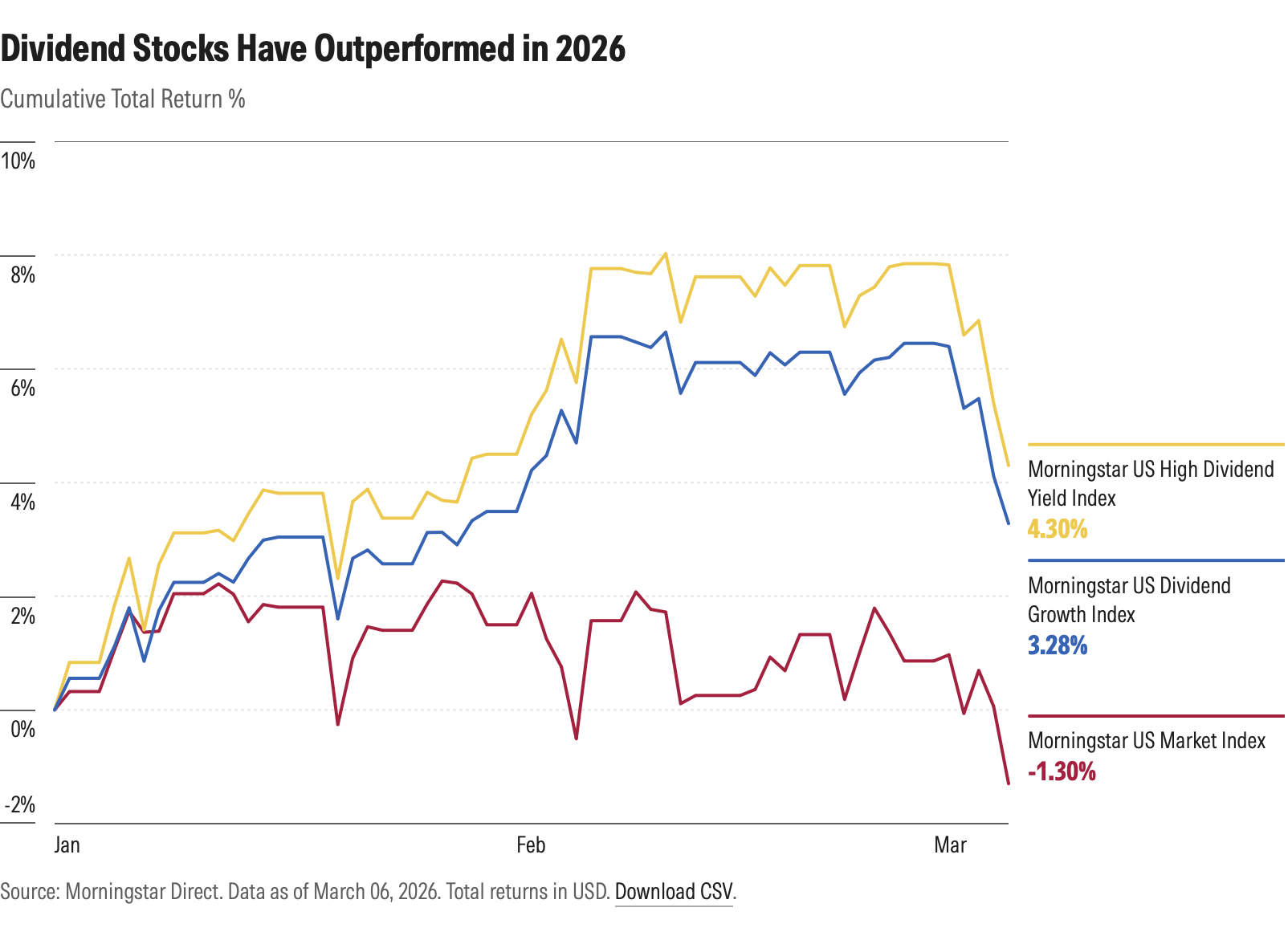
The Dividend Stock Turnaround
Pre-HALO, the performance picture looked very different. In fact, returns over the past three years are a mirror image of what we’ve seen so far in 2026. Both the Morningstar US High Dividend Yield Index and the Morningstar US Dividend Growth Index have lagged the Morningstar US Market Index since early 2023.
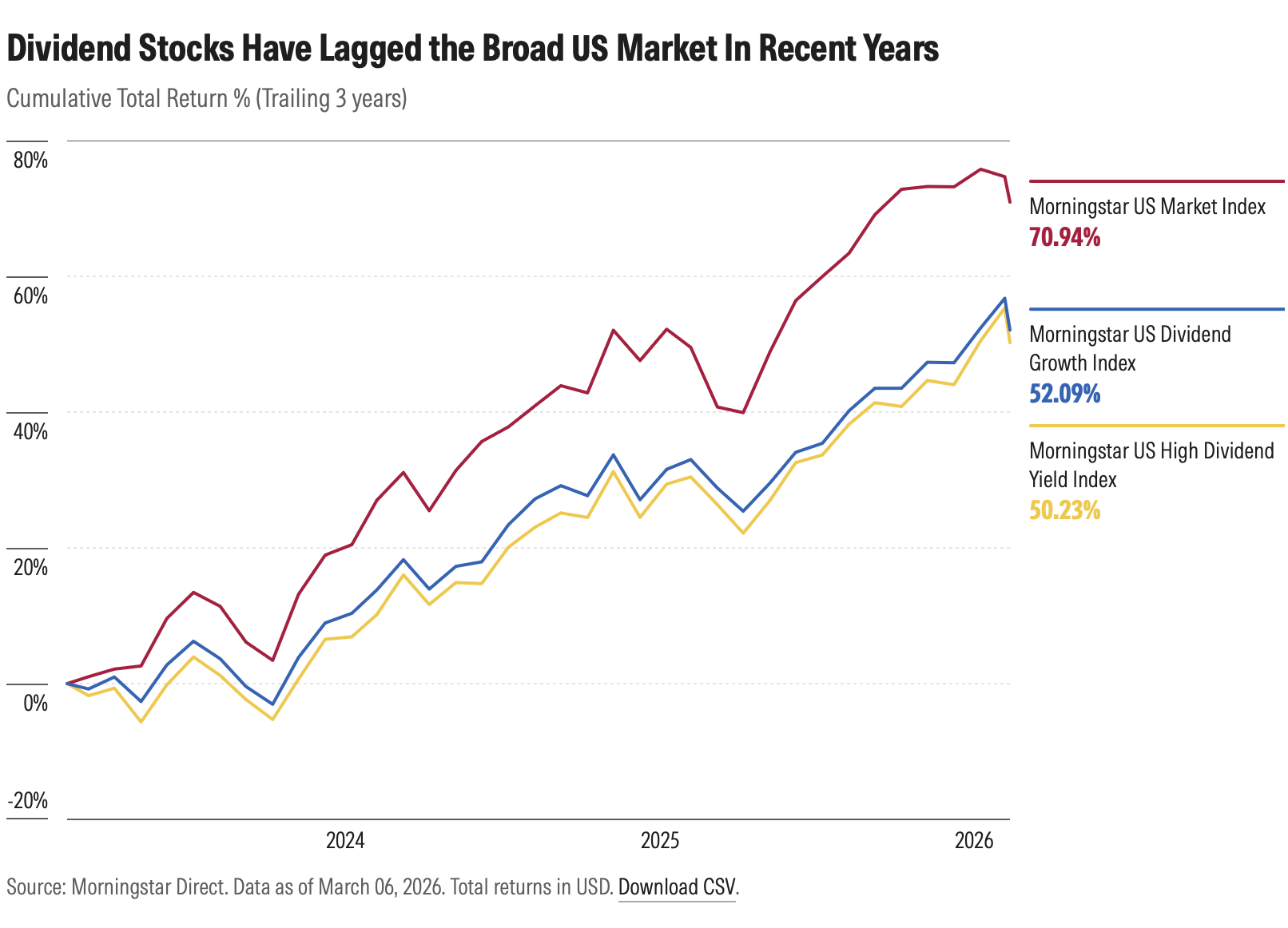
AI is a big part of that story. After the launch of ChatGPT in late 2022, AI enthusiasm lifted the US stock market to ever higher heights. The AI theme mostly favored stocks in the technology and communication-services sectors, which tend to be dividend-light. Market winners have preferred to use cash for share repurchases, or, more recently, massive capital investments in AI infrastructure. Higher-yielding equity sectors like energy, materials, consumer defensives, healthcare, and real estate have lagged.
In a December 2025 interview with Susan Dziubinski, I called out why 2026 could be a “breakout year for dividends.” I mentioned that Morningstar equity analysts saw the prices of many AI-related stocks as reflecting overly optimistic expectations. At that time, they thought valuations were far more reasonable in slower-growing, lower-priced sections of the market. Indeed, as AI enthusiasm has morphed into AI doomerism, investors have flocked to more defensive areas of the market. Companies with tangible assets are perceived to be less susceptible to displacement by AI bots. Meanwhile, the Iran war has given the dividend-rich energy sector a boost by lifting oil prices.
Still, it’s far too early for dividend investors to take victory laps. We’re less than three months into 2026, and anything can happen. In recent years, there have been periods in which dividend stocks outperformed, only to cede leadership. For example, dividend stocks held up relatively well during the tariff-driven selloff of February-April 2025, and before that during a jittery third quarter of 2024. If you go back further, dividend stocks performed admirably in the inflation-driven selloff of 2022. All those resilient episodes get obscured by longer-term performance data.
Setting Expectations for Dividend Stocks
Income is a key consideration for many investors. On an absolute basis, and relative to bonds, dividend yields are low. The Morningstar US High Dividend Yield Index yielded just 2.2% as of February’s end, while the Morningstar US Dividend Growth Index’s yield stood at 2.0%. The broad US stock market is closer to 1%.
From a performance perspective, dividend investors can take solace in several things. First, dividend-focused portfolios have provided a smoother ride than the overall US equity market. Over all trailing periods, the dividend indexes have registered a lower standard deviation of returns (a measure of volatility) than the broad market. Suppressed volatility comports with dividend payer stereotypes: more established, slower growing, and lower priced.
Concentration could also be contributing to the volatility picture. I recently wrote about how the overall US stock market has become increasingly top-heavy and skewed toward the technology sector. The dividend-paying section of the market looks more diffuse and balanced from a sector perspective, including those HALO areas.
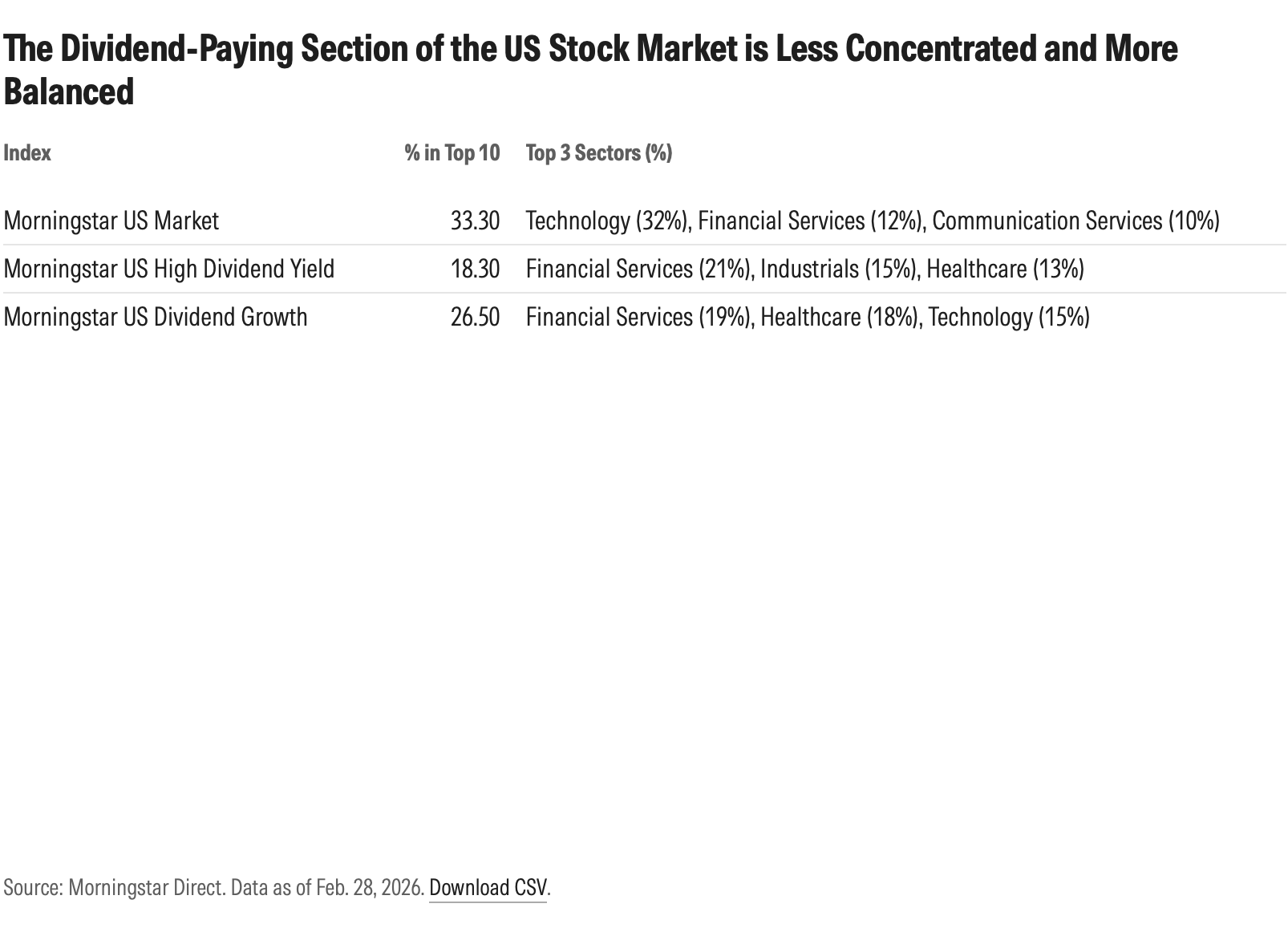
Notice that dividend growth tends to land between the broad market and its high-yield segment. That applies to risk and return. It’s also true when it comes to yield and sector exposures. Focusing on companies that are growing their shareholder payouts results in a portfolio that is more marketlike than homing in on high-yield stocks.
What Does the Future Hold for Dividend Stocks?
Over the very long term, dividend-paying stocks boast a strong track record. Some attribute it to their value orientation. Others say committing to a dividend instills discipline.
Recent decades show that relative returns are highly changeable. Dividend payers have struggled to keep up in a tech-led market (not just over the past three years but going back 10 years and beyond). But if you look at other periods, such as the early 2000s, dividend payers outperformed. Perhaps AI disruption and the HALO Trade will prompt a lasting rotation.
What’s more predictable is volatility and, of course, income. So long as investors are risk-aware—either through diversification or forward-looking screens—high-dividend stocks and dividend growers can be solid investments. Just don’t prioritize yield over total return.
©2026 Morningstar. All Rights Reserved. The information, data, analyses and opinions contained herein (1) include the proprietary information of Morningstar, (2) may not be copied or redistributed, (3) do not constitute investment advice offered by Morningstar, (4) are provided solely for informational purposes and therefore are not an offer to buy or sell a security, and (5) are not warranted to be correct, complete or accurate. Morningstar has not given its consent to be deemed an "expert" under the federal Securities Act of 1933. Except as otherwise required by law, Morningstar is not responsible for any trading decisions, damages or other losses resulting from, or related to, this information, data, analyses or opinions or their use. References to specific securities or other investment options should not be considered an offer (as defined by the Securities and Exchange Act) to purchase or sell that specific investment. Past performance does not guarantee future results. Before making any investment decision, consider if the investment is suitable for you by referencing your own financial position, investment objectives, and risk profile. Always consult with your financial advisor before investing.
Indexes are unmanaged and not available for direct investment.
Morningstar indexes are created and maintained by Morningstar, Inc. Morningstar® is a registered trademark of Morningstar, Inc.